Dog Agility Training: Beginner Guide and 8 DIY Exercises at Home
Dog agility training for beginners: foundation skills, 8 DIY agility exercises you can build at home, a 6-week plan and safety tips for Indian homes and weather.

Quick answer
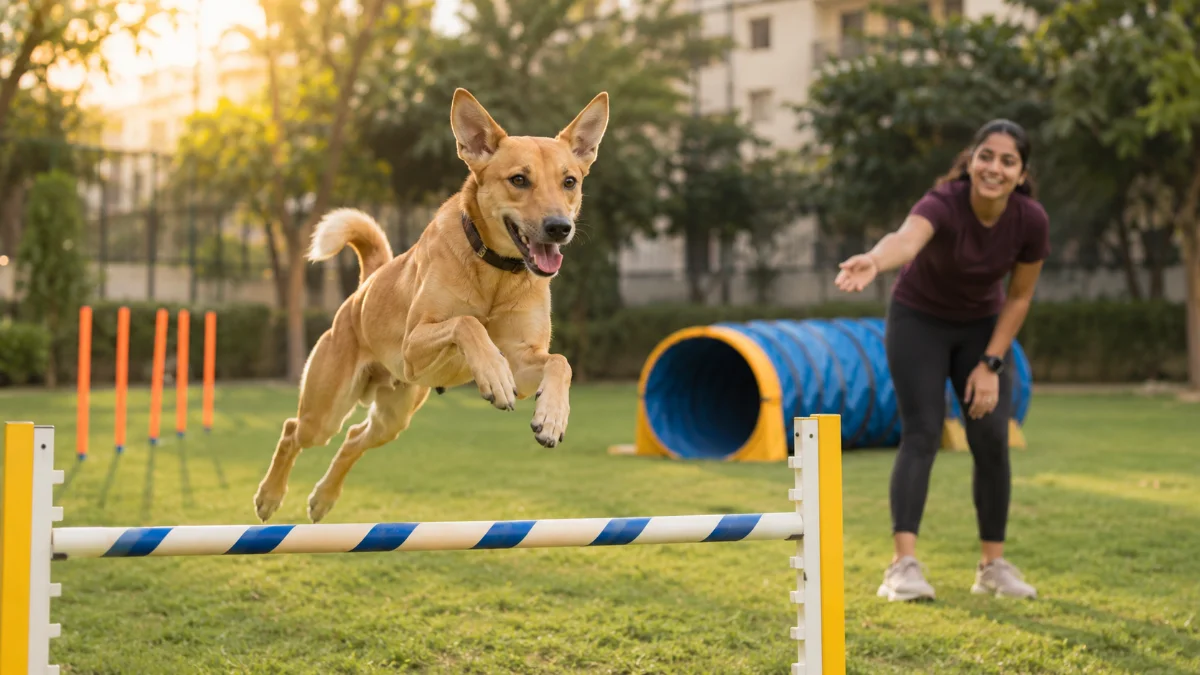
Dog agility training teaches a dog to run a course of jumps, tunnels, weave poles and balance obstacles while following your cues. Start with foundation skills (focus, recall, wait and a nose or paw target), use low, safe obstacles you can make at home, train on grass or rubber mats rather than marble or tiles, keep sessions to 5–10 minutes and reward generously. Get a vet check first, and keep jumps low until your dog has finished growing, usually around 12–18 months.
Agility is one of the most fun things you can do with a dog. Your dog runs, jumps, weaves and balances while you guide it with your voice and body. It burns energy, builds confidence and makes your dog pay far more attention to you, which helps with everyday training too.
You do not need a field full of professional equipment to start. Most beginner agility skills can be taught in a living room, a terrace or a quiet corner of your society park with things you already have at home. This guide explains what dog agility training is, which dogs suit it, the foundation skills to teach first, eight DIY agility exercises, a six-week beginner plan and the safety rules that matter in Indian homes and weather.
What Is Dog Agility Training?
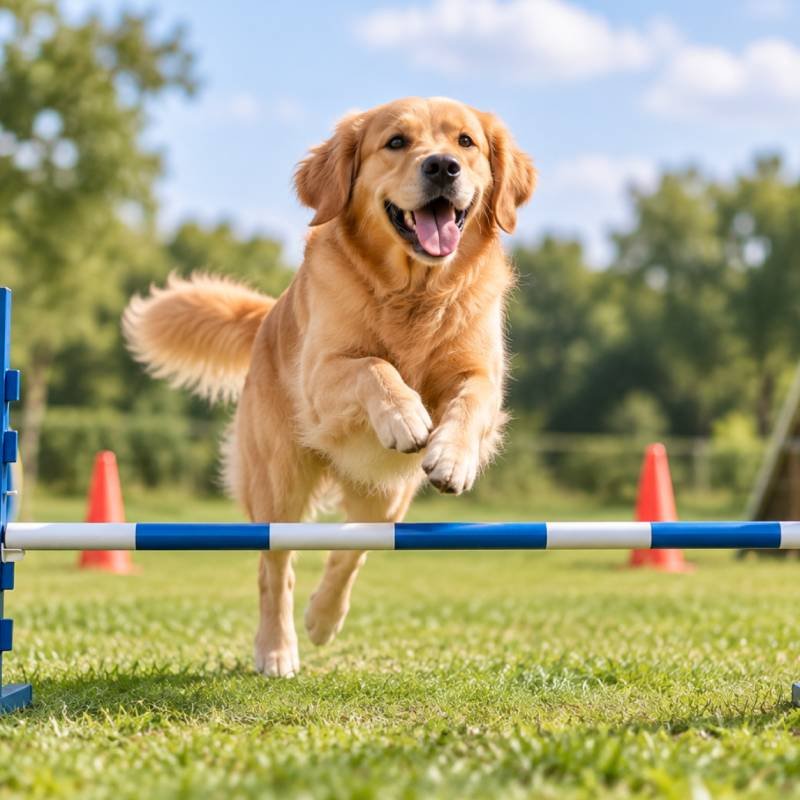
Dog agility is a dog sport in which a handler guides a dog, off-leash, through a set course of obstacles in a set order. In competitions, dogs are judged on speed and accuracy. At home, the goal is simpler: a fitter, happier dog that listens to you, even when it is excited.
The handler cannot touch the dog or the obstacles. Everything is done with verbal cues, hand signals and body position, so agility is really a test of teamwork and communication.
Common agility obstacles
| Obstacle | What the dog does | Skill it builds |
|---|---|---|
| Bar jump | Jumps over a horizontal bar | Coordination, judging height and distance |
| Tyre or hoop | Jumps through a ring | Accuracy and focus |
| Tunnel | Runs through a fabric tube | Confidence in enclosed spaces |
| Weave poles | Weaves in and out of a line of upright poles | Body control, the hardest skill to learn |
| A-frame and dog walk | Climbs up and down ramps or a narrow plank | Balance and careful foot placement |
| See-saw (teeter) | Walks a plank that tips | Confidence on moving surfaces |
| Pause table | Jumps on a platform and holds a sit or down | Self-control while excited |
Benefits of Agility Training for Dogs
- Physical exercise: running, jumping and turning work the whole body.
- Mental exercise: learning a course and listening for cues tires the brain as much as the legs. Ten minutes of agility can settle a dog better than a long, boring walk.
- Better listening: agility builds focus, recall and impulse control that carry over to everyday life.
- Confidence: shy dogs often grow braver as they master new surfaces and obstacles.
- A stronger bond: you and your dog learn to read each other as a team.
- Less problem behaviour: many dogs that chew, dig or bark from boredom calm down when they get regular brain work.
Which Dogs Are Good for Agility?
Almost any healthy dog can enjoy simple agility games. Some breeds take to it naturally:
- Natural athletes: Border Collies, Australian Shepherds, Belgian Malinois, Labradors, Golden Retrievers, Jack Russell Terriers and Indies, which are often light, quick and nimble.
- Great with adjustments: Beagles, Cocker Spaniels, German Shepherds and Dobermans. Keep jumps low for heavier dogs.
- Low-impact only: flat-faced breeds such as Pugs, Shih Tzus and Bulldogs overheat quickly, so stick to tunnels, targets and walking over poles on the ground, in cool weather. Long-backed breeds like Dachshunds should avoid jumps and A-frames altogether. See our guide to Dachshund back health.
- Senior dogs: gentle versions, such as walking through a tunnel or stepping over low poles, keep older minds busy. Ask your vet first. Our senior dog care tips cover safe exercise.
When Can a Puppy Start Agility?
Puppies can start foundation games, such as targets, tunnels, walking over a plank on the ground and following your hand, from about 8–10 weeks. Real jumping and weaving should wait. A puppy’s growth plates, the soft areas at the ends of the long bones, are still developing, and repeated jumping can damage them.
| Age | What is safe |
|---|---|
| 8 weeks – 6 months | Focus games, name response, targets, short tunnels, walking over poles lying flat on the ground |
| 6–12 months | Wobble boards, low planks, jumps no higher than the wrist, introduction to weave poles with wide gaps |
| 12–18 months and over | Gradually higher jumps and full obstacles once your vet confirms growth has finished. Large and giant breeds often need until 18–24 months |
For competition, the American Kennel Club only allows dogs aged 15 months and over, which gives you an idea of how carefully young joints should be treated.
Foundation Skills to Teach Before Any Obstacle
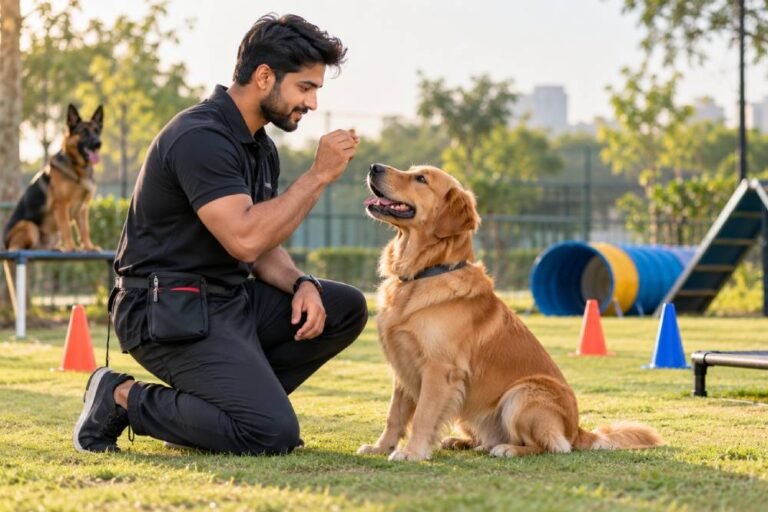
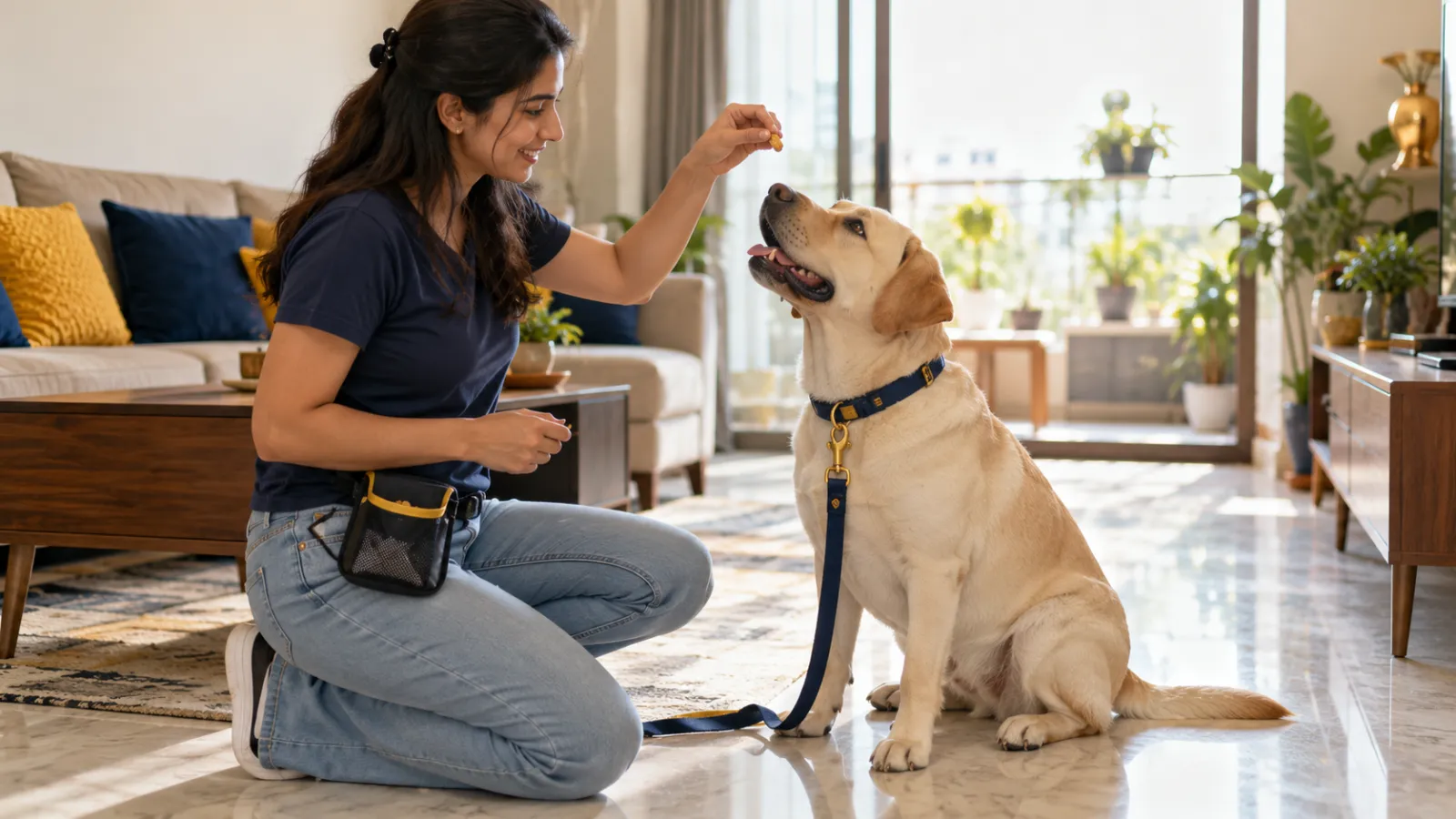
Agility is built on basic obedience. Teach these first, at home, with small treats:
- Focus: your dog looks at you when you say its name, even with a toy nearby.
- Recall: your dog comes straight back when called. Our guide to teaching your dog to come when called explains how.
- Wait or stay: your dog holds still at the start line until you release it. See our list of basic dog commands.
- A release word: “okay” or “free” tells your dog it can move.
- Hand target: your dog touches its nose to your open palm. You will use this to guide it around the course.
- Left and right: your dog follows your hand to either side of your body.
- Body awareness: stepping over poles, backing up a few steps and putting front paws on a low box all teach a dog where its feet are.
8 DIY Dog Agility Exercises at Home
You do not need to buy an agility kit to begin. These home-made versions are safe for beginners. Always set obstacles on a non-slip surface.
1. Broomstick jump
Rest a broom handle across two buckets, stacks of books or shoe boxes so it sits just a few centimetres off the floor. Lure your dog over it with a treat, say “over” as it crosses, and reward on the other side. The bar should fall off easily if your dog touches it. Raise it only after your dog is confident and fully grown.
2. Hula hoop tyre
Hold a hula hoop upright with the bottom touching the floor. Toss a treat through it so your dog walks through. Then add the cue “through” and slowly lift the hoop a few centimetres.
3. Blanket or box tunnel
Drape a bedsheet over two chairs, or open both ends of a large cardboard box. Start with a short tunnel where your dog can see you at the other end. Call it through and reward. A collapsible children’s play tunnel works well once your dog is confident.
4. Bottle weave poles
Line up six water bottles filled with water, or cones, about 60 cm apart. Use a treat in your hand to lure your dog in and out of the line, slowly. Weaving is the hardest agility skill, so expect it to take weeks. Always enter with the first pole on your dog’s left.
5. Plank dog walk
Lay a wide, sturdy plank flat on the ground and teach your dog to walk its full length. Later, raise it just a few centimetres on bricks. Hold a treat at your dog’s nose to keep it slow and steady.
6. Pause table
Use a low, stable step, an ottoman or a folded yoga mat. Teach your dog to hop up, sit or lie down, wait for a count of five and then wait for your release word. This builds self-control in the middle of excitement.
7. Pole grid (cavaletti)
Lay four or five broom handles or PVC pipes flat on the ground, about one stride apart. Walk your dog over them slowly. It builds rhythm, coordination and careful foot placement, and it is gentle enough for puppies and seniors.
8. Mini course
When your dog knows three or four obstacles, put them in a short line: jump, tunnel, hoop, table. Run it together, cue each obstacle, and finish with a big reward. Change the order often so your dog listens instead of memorising.
For more rainy-day ideas, see our list of indoor games for dogs.
A 6-Week Beginner Agility Plan
| Week | Focus | Goal by the end of the week |
|---|---|---|
| 1 | Name response, hand target, release word | Your dog touches your palm on cue and waits for “okay” |
| 2 | Pole grid and plank on the ground | Walks over poles and along the plank calmly |
| 3 | Tunnel and hoop | Goes through both on cue from a short distance |
| 4 | Low broomstick jump and pause table | Jumps a low bar and holds a sit on the table for five seconds |
| 5 | Weave poles with wide gaps, left and right cues | Follows your hand through three or four poles |
| 6 | Link obstacles into a three- or four-piece course | Runs a short course with you, start to finish |
Train for 5–10 minutes a day, once or twice. Stop while your dog still wants more.
Safety Tips for Agility in Indian Homes and Weather
- Get a vet check first, especially for puppies, heavy dogs, seniors and breeds prone to joint problems.
- Mind the floor. Marble, vitrified tiles and polished wood are slippery. Use grass, rubber gym mats, carpet or yoga mats under every obstacle.
- Beat the heat. In Delhi NCR summers, train only early in the morning or late in the evening, keep water handy and stop at the first sign of heavy panting. Learn the signs of dehydration in dogs.
- Check the air. On high-pollution days, keep sessions short and indoors. Our guide to dog walking in Delhi pollution explains when to cut back.
- Warm up and cool down with a few minutes of easy walking before and after.
- Keep jumps low. A good rule for beginners is no higher than your dog’s elbow, and lower for puppies.
- Make everything stable. Planks, tables and boxes must not wobble or slide unless you are deliberately teaching a wobble board.
- Do not train after a meal. Wait at least an hour after feeding before running and jumping.
- Use only rewards. Never pull, push or force a dog over or through an obstacle. Fear on one obstacle can spread to the whole course.
Common Mistakes in Agility Training
- Skipping the foundations. A dog without a solid recall and wait will struggle on a course.
- Raising jumps too soon. Height is the least important skill. Accuracy and confidence come first.
- Training too long. Tired dogs knock bars, slip and lose interest.
- Repeating the same course every day. Your dog memorises the pattern instead of listening to you.
- Ignoring stress signs. Sniffing the floor, yawning, slowing down or leaving the area mean your dog needs a break or an easier step.
Can a Trainer Help With Agility?
Agility builds on everyday obedience. If your dog does not yet have a reliable sit, stay, recall and loose-leash walk, those are the skills to fix first. OrigiZnPets trainers teach these foundations at your home and show you how to keep practising between sessions. See our dog obedience training guide for what that involves.
Want a trainer to build the basics? Our reward-based trainers visit homes across Delhi NCR and the Chandigarh Tricity, including Noida, Gurgaon, South Delhi and Chandigarh. Single sessions start at ₹799, and the first visit is a free demo at your home.
High-energy dog that is bored at home? Try our 10 indoor games for dogs on days when you cannot get outside.
Frequently Asked Questions
What is dog agility training?
Dog agility training teaches a dog to complete a course of obstacles such as jumps, tunnels, weave poles and ramps, guided only by the handler’s voice and body language. It is great exercise for both the body and the mind.
Can I do dog agility training at home?
Yes. Most beginner skills can be taught at home with household items: a broom on two buckets for a jump, a hula hoop for a tyre, a blanket over chairs for a tunnel and water bottles for weave poles. Use a non-slip surface.
At what age can a dog start agility?
Puppies can start foundation games from about 8–10 weeks, but should not do repeated jumping until they have finished growing, usually 12–18 months, and later for large breeds. Ask your vet before raising jumps.
Is agility good for all dogs?
Most healthy dogs enjoy some form of agility. Flat-faced breeds, long-backed breeds such as Dachshunds, overweight dogs and seniors should stick to low-impact versions without high jumps, after a vet check.
How long does it take to train a dog for agility?
Most dogs can run a simple three- or four-obstacle course within four to six weeks of short daily practice. Weave poles and contact obstacles take several months to perfect.
What equipment do I need to start?
Very little: small soft treats, a toy your dog loves, a non-slip surface and a few household items. Buy proper equipment, such as adjustable jumps and a training tunnel, only once you know your dog enjoys it.
Is agility good for anxious or reactive dogs?
Home agility often builds confidence in shy dogs. Group agility classes can be too stimulating for reactive dogs, so work on reactivity first. Our reactive dog training guide explains how.
How often should I practise agility?
Short sessions of 5–10 minutes, once or twice a day, work best. Give your dog at least one rest day a week from jumping.
Related reading: How to Train a Dog · Dog Training Treats · Best Dog Breeds for Apartments in India · How Often Should You Walk Your Dog