
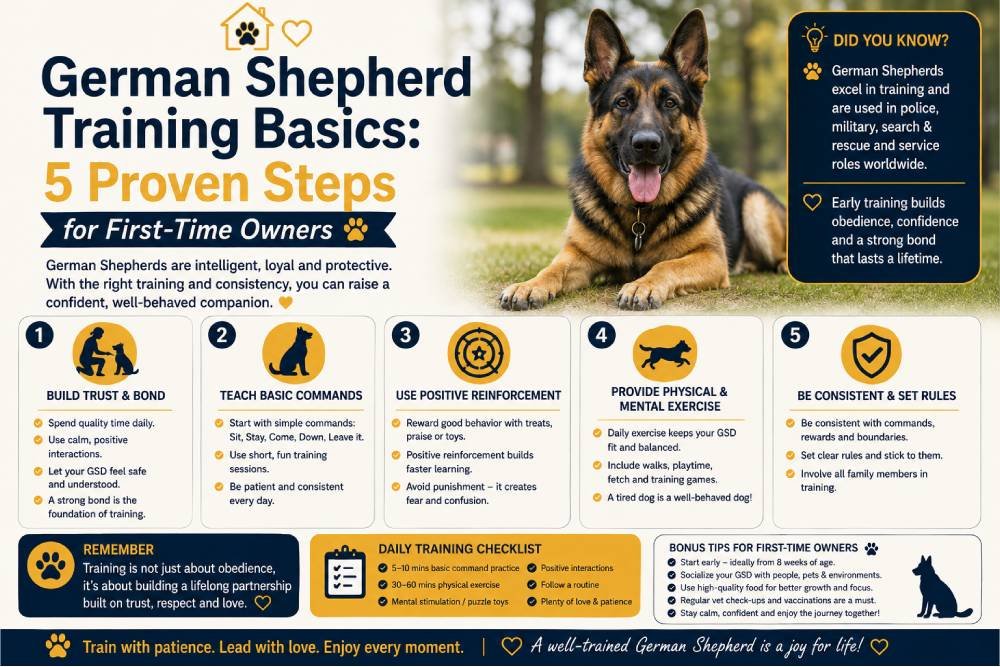
German Shepherd Training Basics: 5 Proven Steps for First-Time Owners
German shepherd training tips for first-time owners: 5 proven steps to channel this breed's intelligence and drive constructively.

German shepherd training tips written for an already-experienced handler often assume a baseline of confidence that a first-time owner simply doesn’t have yet. This is a highly intelligent, high-drive breed, and that combination means undirected energy turns into problem behaviour faster than it would with a lower-drive dog.
German shepherd training tips: Five proven german shepherd training steps
- Start structured training in puppyhood, not after problems appear. This breed’s intelligence means they learn bad habits just as fast as good ones.
- Give them a job, even a small one. German Shepherds were bred as working dogs, and structured tasks — carrying a small item, following a specific routine — satisfy a need that free play alone doesn’t.
- Be consistent about rules from day one. This breed notices inconsistency quickly and will test boundaries that shift.
- Socialise deliberately and early, since German Shepherds can be naturally reserved with strangers, and poor early socialisation tends to become genuine wariness or reactivity as adults.
- Use reward-based methods, not dominance-based ones. Older training advice for this breed leaned heavily on correction-based methods that current behaviour science doesn’t support.
An under-stimulated German Shepherd isn’t a calm German Shepherd — it’s one waiting for a job you haven’t given it yet.
Why reward-based training matters especially for this breed
The American Veterinary Society of Animal Behavior’s position statement on humane dog training notes there is no evidence that aversive methods are more effective than reward-based ones, and that punishment-based approaches carry a higher risk of triggering fear or aggression — a particularly relevant caution for a breed already predisposed to protective instincts.
What first-time owners underestimate about this breed
German Shepherds are often chosen specifically for their intelligence, but that same intelligence means they get bored with repetitive training faster than lower-drive breeds. Varying training exercises, and gradually increasing difficulty, keeps this breed engaged in a way that repeating the same basic commands doesn’t.
Exercise needs beyond a daily walk
A single walk, however long, rarely satisfies this breed’s need for mental engagement. Scent work, obedience drills, or structured play that requires problem-solving does more for a German Shepherd’s overall behaviour than additional physical exercise alone. Rotating between two or three different mental activities across the week, rather than repeating the same one daily, keeps this breed genuinely engaged rather than merely occupied.
Our training and walking services build structured, job-oriented routines specific to working breeds like German Shepherds. Book a free demo to start training built around this breed’s actual needs.
Common mistakes first-time German Shepherd owners make
Assuming size and confidence mean a puppy needs less structure, skipping socialisation because the puppy “seems fine” with people already met, and relying on the breed’s reputation instead of actual observed behaviour are the three mistakes that show up most often. This breed’s reputation for intelligence and protectiveness can lead new owners to either overestimate how much training happens automatically, or become overly cautious in ways that limit healthy socialisation. Neither extreme serves the dog well, and the middle ground — genuine structure paired with genuine exposure — is what actually works.
What a well-trained German Shepherd actually looks like day to day
Calm default behaviour indoors, reliable recall even around distractions, and comfortable — not anxious — greetings with familiar visitors are realistic goals with consistent training. This breed’s working heritage means genuine reliability is achievable, but it comes from deliberate structure built over months, not an assumption that intelligence alone gets a dog there. Owners who invest that structure early tend to describe their adult German Shepherd as remarkably easy to live with — a stark contrast to the reactive, hard-to-manage reputation the breed sometimes gets from cases where training was skipped.