
Puppy Socialization Tips: 6 Essential Steps to Avoid Common Mistakes
Puppy socialization tips that actually build confidence: 6 essential steps, and the common mistakes that undo months of work.

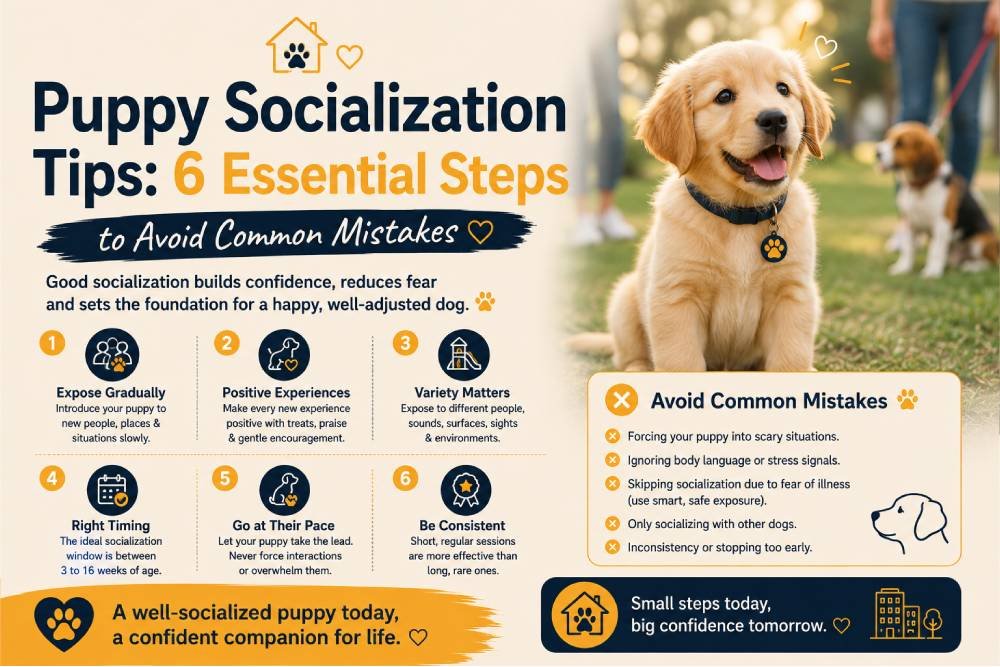
Puppy socialization tips usually get reduced to one instruction: expose your puppy to as much as possible, as early as possible. That advice, taken literally, causes almost as many problems as it solves. Quantity of exposure matters far less than whether each experience actually ends calm.
Why most puppy socialization tips miss the real goal
The point of socialization isn’t accumulating a checklist of things your puppy has “seen.” It’s teaching your puppy that new people, sounds and surfaces are unremarkable. A puppy dragged through a crowded market and overwhelmed learns the opposite lesson — that new things are stressful — even though technically the exposure “happened.”
Six essential puppy socialization tips
- Watch the body language, not the clock. A relaxed tail and loose body language matter more than how many minutes an interaction lasted.
- End sessions while your puppy is still curious, not once they’ve become overwhelmed. Ending on stress teaches the wrong lesson.
- Prioritise variety over volume. Ten different calm, brief exposures across a week beat one long overwhelming outing.
- Let your puppy approach, don’t force it. A puppy that hangs back from a new person or object needs space, not encouragement to push through.
- Pair new experiences with something good — a treat, a favourite toy — so the association forms deliberately, not by chance.
- Include everyday sounds, not just people and other dogs — doorbells, vacuum cleaners, traffic, lifts — since these cause as many adult behaviour issues as poor socialisation with people does. A puppy that’s never heard a vacuum up close often reacts with real alarm the first time as an adult, simply because nobody thought to include it early.
A puppy that’s seen everything but calm about none of it hasn’t actually been socialised — it’s been exposed.
The window that matters most
Most of a puppy’s lasting comfort with the world is shaped in the first few months, which is why these puppy socialization tips matter more early than later. That doesn’t mean socialisation stops afterward — it means the early weeks carry outsized weight, and a few rushed or overwhelming experiences in that window can take much longer to undo than they took to create.
What to do if a session goes badly
If a puppy startles badly at something during socialisation, resist the urge to immediately re-expose them “to get over it.” Give distance, let them settle, and try a milder version of the same trigger later rather than repeating the overwhelming version. Forcing continued exposure after a strong fear reaction almost always makes the association worse, not better, even when the intention behind it is to “build confidence.” The American Veterinary Society of Animal Behavior’s position statement on humane training methods notes that reward-based approaches carry the lowest welfare risk and are recommended over any method relying on flooding a fearful animal with the trigger itself.
Our training and walking services include structured puppy socialisation built around your specific puppy’s pace, not a generic checklist. Book a free demo to get started at home.
A simple weekly structure that works
Rather than planning one big outing, spread three or four short, deliberate exposures across the week — a new surface one day, a calm meeting with a friend’s vaccinated dog another, a car ride on a third, or a brief visit to a quiet new environment. This spacing gives your puppy time to process each experience before the next one arrives, which is exactly what turns exposure into genuine comfort. Keep a simple mental note of what’s gone well and what caused hesitation, since that pattern tells you far more about what to prioritise next week than any generic checklist could.