
Reading your dog’s body language on a walk
Tail position, ear angle and pace tell you more than barking ever will.

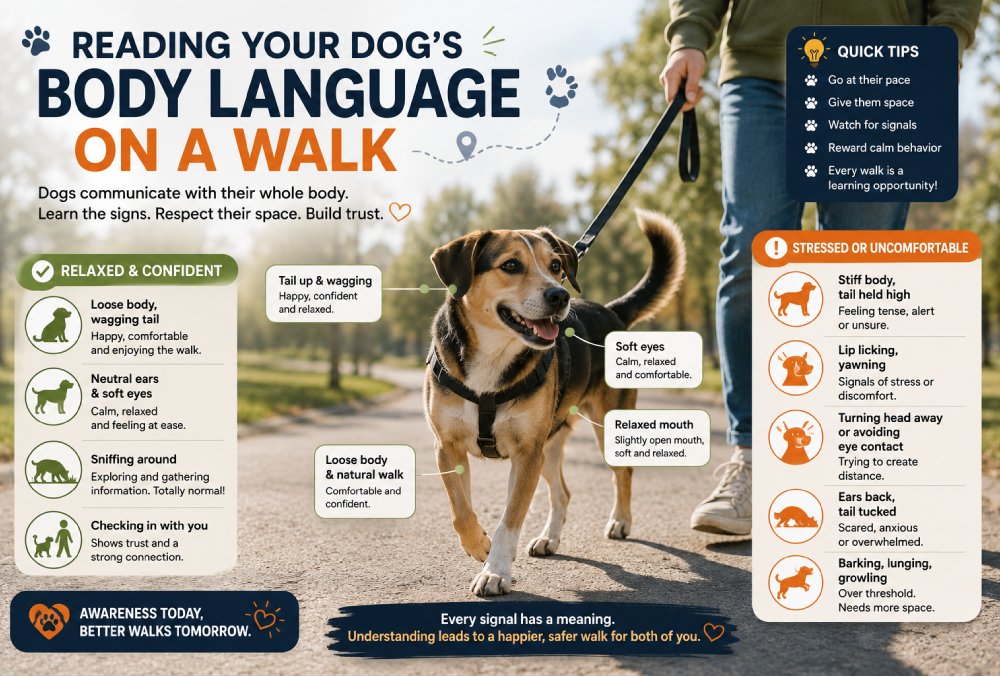
Barking is the last signal, not the first. By the time a dog barks at another dog across the road, it has usually given three or four quieter signals that were easy to miss. Learning to read those signals early is what turns a tense walk into an uneventful one.
Watch the top line first
Tail height tells you arousal, not mood. A high, stiff tail with short wags is a dog on alert. A low, loose tail swinging with the whole back end is a relaxed dog. A tail tucked flat under the belly is fear, and fear is where most leash reactivity starts.
Then the head and pace
Ears forward and a hard stare mean your dog has locked on to something. A quick lip lick, a yawn out of nowhere or a sudden sniff at the ground are displacement signals: the dog is uncomfortable and trying to defuse.
A dog that slows down and stiffens is asking for space. Give it before you have to ask for calm.
What to do with the information
- Add distance early. Crossing the road at 20 metres is easier than managing at 5.
- Change direction while your dog can still hear you.
- Reward the moment your dog looks back at you, not after it has settled.
Our walkers log these moments in the walk report, so patterns show up over a week instead of getting lost in one bad evening.