

Choosing the Right Dog Food by Breed: 5 Proven Guidelines
Choosing dog food by breed made simple: 5 proven guidelines that account for size, activity level and breed-specific health risks.

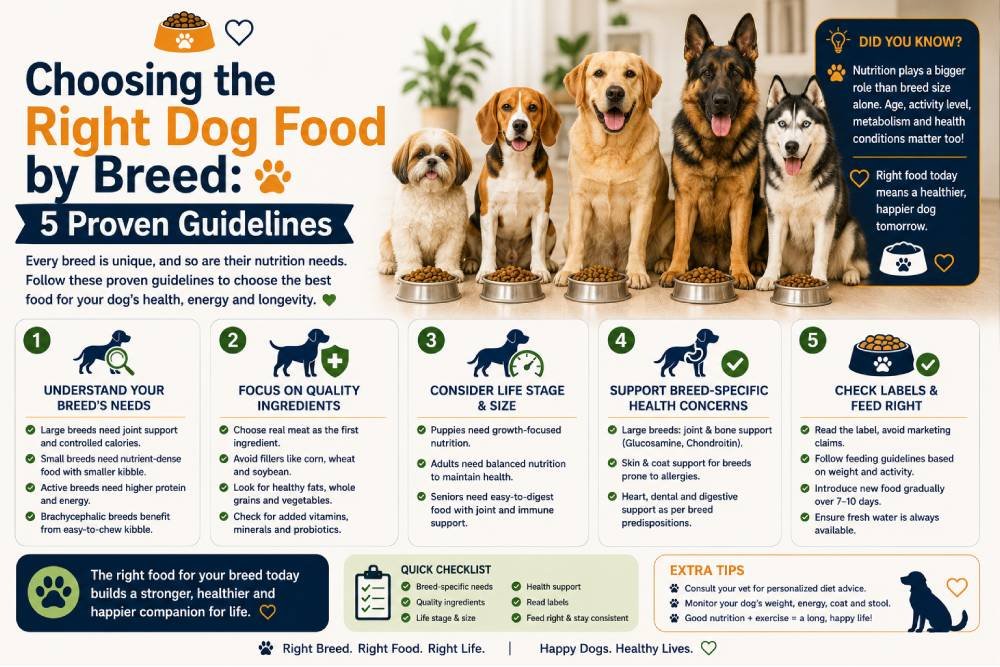
Choosing dog food by breed goes beyond reading the marketing on a bag labeled for a specific size category. Breed-specific nutrition needs come from real physiological differences — metabolism, joint structure, known health predispositions — not just adult weight.
Five proven guidelines for choosing dog food by breed
- Match calorie density to activity level, not just size. A working-line German Shepherd and a low-energy senior Labrador of similar weight have very different actual calorie needs.
- Consider joint-support formulas for large, fast-growing breeds like Labradors and Golden Retrievers, where controlled growth reduces long-term joint stress and pays off well into a dog’s senior years.
- Watch calorie-dense food closely for breeds prone to obesity, particularly Labradors and Pugs, where a genetic tendency toward weight gain makes portion discipline more important than food quality alone, even with a premium formula.
- Choose easily digestible formulas for brachycephalic breeds like Pugs and Shih Tzus, since their airway structure already predisposes them to swallowing air and gastrointestinal discomfort.
- Don’t assume “breed-specific” packaging means nutritionally optimal. Read the actual ingredient and calorie information rather than relying on the size category printed on the bag.
The right food for a breed isn’t about the label — it’s about matching calorie density and nutrient profile to that dog’s actual activity level and known health risks.
Why large-breed puppies need different formulas than small-breed ones
Large-breed puppy formulas are specifically calibrated to slow growth rate slightly, reducing stress on developing joints during the fastest-growing months. Feeding a large-breed puppy a standard or small-breed formula can contribute to growing too fast for their joints to keep pace, a factor linked to higher rates of hip and elbow dysplasia later — one of the more consequential nutrition decisions an owner makes in the first year. The World Small Animal Veterinary Association’s Global Nutrition Toolkit specifically recommends large-breed-appropriate growth formulas to help control the rate of weight gain relative to skeletal development in fast-growing breeds.
Reading past marketing claims on packaging
Terms like “premium” or “breed-specific” aren’t regulated the way actual nutritional content is. Checking the guaranteed analysis panel and ingredient list matters more than the marketing copy, particularly for breeds with known sensitivities like Shih Tzus and Pugs, where a poorly matched formula can worsen an already-present issue rather than simply being a neutral choice.
When to consult a vet before choosing
Breeds with known predispositions to specific conditions — joint issues in large breeds, dental crowding in Shih Tzus, obesity in Labradors — benefit from a vet’s specific input rather than a generic breed-based recommendation, especially once a dog has an established weight or health history to factor in. A quick conversation at a routine checkup is usually enough to confirm whether a change is worth making.
Our training and walking services factor exercise and feeding routines together, since the two directly affect each other for weight-prone breeds. Book a free demo to talk through your dog’s specific needs.
How often to reassess your dog’s food as they age
A food that suited an active young adult often needs adjusting once a dog enters their senior years, when activity typically drops and calorie needs decrease correspondingly. Reassessing every year or two, rather than assuming the same food remains appropriate indefinitely, prevents the slow weight gain that’s especially risky for breeds already prone to it, and a vet weigh-in at each checkup makes this easy to track objectively.
Treats count more than most owners realise
Training treats and table scraps add up quickly, particularly for smaller breeds where even a small amount represents a larger percentage of daily calories. Factoring treats into the overall daily intake, rather than treating them as separate from “real food,” matters especially for breeds already prone to weight gain, and it’s an easy adjustment most owners haven’t considered.