
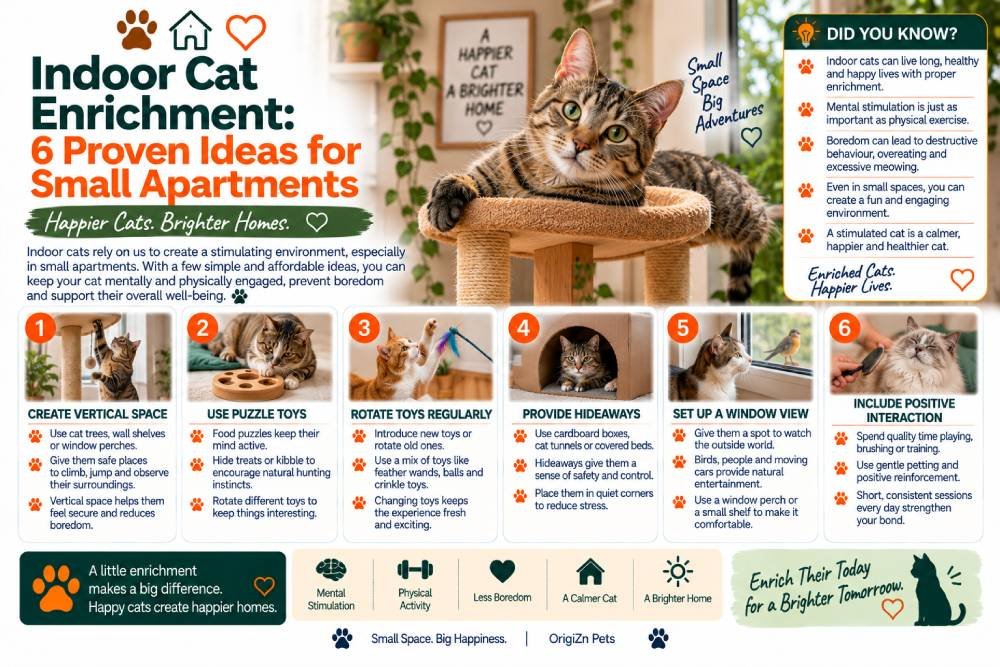
Indoor Cat Enrichment: 6 Proven Ideas for Small Apartments
Indoor cat enrichment ideas that work in small apartments: 6 proven ways to keep an indoor-only cat mentally and physically satisfied.

Indoor Cat Enrichment Ideas: 6 Proven Ways to Keep Cats Happy
Indoor cat enrichment ideas are important because living indoors does not automatically provide every opportunity a cat needs to climb, explore, hunt, scratch, play, and rest. Without enough mental and physical stimulation, some indoor cats may become bored, frustrated, or develop unwanted behaviors.
The good news is that enriching your cat’s environment does not have to mean buying expensive furniture or filling every room with toys. Simple changes such as adding a window perch, using food puzzles, rotating toys, creating vertical space, and scheduling interactive play can make an indoor environment much more interesting.
Every cat is different, so the best enrichment plan depends on your cat’s age, personality, mobility, food preferences, and environment. The goal is to create regular opportunities for natural behaviors while allowing your cat to choose what they enjoy.
6 Indoor Cat Enrichment Ideas to Try at Home
The best indoor cat enrichment ideas do not need to be complicated. Start with a few simple activities and gradually build an environment that gives your cat opportunities to move, explore, investigate, play, and relax.
- Create vertical space with a cat tree, sturdy shelves, or a secure window perch.
- Use puzzle feeders to turn some meals into opportunities for searching and foraging.
- Rotate toys so your cat regularly experiences something different instead of seeing the same toys every day.
- Provide a safe window view where your cat can watch birds, people, insects, and other outdoor activity.
- Schedule interactive play that encourages stalking, chasing, pouncing, and catching.
- Introduce safe textures and objects such as cardboard boxes, tunnels, and appropriate cat-safe items.
1. Create Vertical Space for Climbing and Watching
One of the most effective indoor cat enrichment ideas is giving your cat access to vertical territory. Cats often enjoy being above the ground because elevated spaces allow them to observe their surroundings while providing a comfortable place to rest.
A cat tree, sturdy shelf, climbing tower, or secure window perch can increase the usable space inside your home without requiring a larger floor area. This can be particularly helpful if you live in an apartment or a smaller home.
Vertical areas can also give cats a place to retreat when they want some distance from people, children, or other pets. Ideally, provide a stable location where your cat can climb safely and relax without being disturbed.
The Ohio State University Indoor Pet Initiative recommends providing elevated perches that allow cats to observe their environment and highlights the value of vertical space for indoor cats.
You do not need to build an elaborate climbing wall. Even one secure elevated resting place can give your cat another meaningful area to explore.
2. Turn Mealtime Into a Hunting and Foraging Activity
A food bowl provides nutrition, but feeding can also become an opportunity for mental stimulation. Instead of serving every meal in exactly the same way, consider using an appropriate puzzle feeder or hiding small portions of your cat’s normal food around safe areas of the home.
This encourages your cat to search, investigate, and work for food rather than simply eating from a bowl. For many indoor cats, this is an easy way to introduce more activity into an otherwise predictable day.
Start with a simple puzzle that your cat can solve easily. If the challenge is too difficult, your cat may lose interest. Once your cat understands the activity, you can gradually introduce different food puzzles or hiding locations.
Make sure food used for enrichment is included within your cat’s normal daily calorie intake. Treats and puzzle-feeder portions should not become an accidental source of excessive calories.
The Ohio State University Indoor Pet Initiative provides additional information about environmental enrichment, including opportunities for indoor cats to engage in hunting and foraging behaviors.
3. Rotate Toys Instead of Leaving Everything Out
Another simple indoor cat enrichment idea is to rotate toys regularly. Cats can lose interest when the exact same toys remain available all the time.
Instead of leaving every toy on the floor, keep some safely stored away and offer a small selection at a time. After several days or weeks, switch them around.
A toy that your cat previously ignored may become interesting again after being unavailable for a while. This approach can also save money because you do not need to constantly purchase new toys to create novelty.
Try different types of toys that encourage different behaviors. Some cats prefer toys they can chase, while others enjoy batting objects, stalking moving toys, searching for hidden items, or interacting with food puzzles.
Watch your cat’s preferences and adjust the rotation accordingly. Enrichment is most effective when the activity matches the individual cat.
4. Provide a Safe Window View
A window can provide hours of passive stimulation for some indoor cats. A secure place near a window allows your cat to watch birds, insects, people, weather, and other activity outside.
Place a stable perch near a suitable window where your cat can comfortably sit or lie down. If the window receives sunlight, make sure your cat also has access to shade and another comfortable resting location.
Not every cat will be interested in watching outside, and that is perfectly normal. Some cats may prefer a quieter part of the home, while others will spend significant amounts of time observing what happens outdoors.
Window safety is essential. Make sure screens are secure and that your cat cannot accidentally fall or escape through an open window.
A safe window area is particularly useful because it provides environmental stimulation without requiring you to constantly interact with your cat.
5. Schedule Short Interactive Play Sessions
Interactive play is one of the most valuable indoor cat enrichment ideas because it gives your cat an opportunity to engage in behaviors related to stalking, chasing, pouncing, and catching.
Use appropriate interactive toys to imitate prey movement. Instead of moving the toy constantly at the same speed, vary the movement. Let your cat watch, stalk, chase, and occasionally catch the toy.
Several short sessions throughout the day can be easier to maintain than one long session. Even a few minutes of focused play can provide useful stimulation when it becomes part of a consistent routine.
Try scheduling play around your existing routine, such as before breakfast or dinner. This can make enrichment easier to remember and can create a predictable sequence for your cat.
Never encourage your cat to attack hands or feet during play. Using appropriate toys helps your cat learn that human hands are not prey.
6. Introduce Safe Textures, Scents, and Objects
Cats experience their environment through multiple senses, so enrichment does not always need to involve traditional toys.
Cardboard boxes, tunnels, paper bags with handles removed, different resting surfaces, and other safe household objects can encourage exploration.
Introduce new objects gradually. Some cats will immediately investigate something new, while others may prefer to observe it from a distance before approaching.
Novelty can be valuable, but too much change at once can make some cats uncomfortable. Give your cat the choice to investigate or ignore a new object.
If you introduce plants into your home, always check that the specific plant is safe for cats before allowing your pet access to it.
Why Indoor Cat Enrichment Matters
Indoor living can provide cats with a safe environment, but safety and stimulation are not the same thing. Cats still have behavioral needs even when they never go outside.
The Feline Veterinary Medical Association recommends that indoor cats have opportunities for behaviors such as simulated hunting and foraging, play, climbing, scratching, resting, and exploring their environment.
This is why enrichment should be considered part of everyday cat care rather than something reserved only for cats that appear bored.
A well-enriched environment gives your cat choices. Your cat should be able to decide when to play, where to rest, where to climb, and when to investigate something new.
Signs Your Indoor Cat May Need More Enrichment
There is no single behavior that proves a cat is bored. Cats have different personalities, and some naturally sleep more or prefer quiet activities.
However, changes such as excessive vocalization, destructive scratching, rough play directed toward people, persistent attention-seeking, increased grooming, or unusual restlessness may indicate that something in the environment needs attention.
Behavior should always be considered in context. A sudden change should not automatically be blamed on boredom.
Pain, illness, anxiety, household changes, litter box problems, and other environmental factors can also cause behavioral changes.
If your cat suddenly changes behavior, stops eating, changes litter box habits, grooms excessively, becomes unusually withdrawn, or shows signs of pain, speak with your veterinarian.
Indoor Cat Enrichment Ideas on a Budget
You do not need to spend hundreds of dollars to create an interesting environment. Some of the best indoor cat enrichment ideas use simple items that you may already have at home.
- Cardboard boxes: Provide temporary hiding and exploring spaces.
- Paper bags: Use bags without handles for supervised exploration.
- Blankets and fabrics: Offer different comfortable surfaces for resting.
- Window perches: Create a safe observation point.
- Food puzzles: Turn part of a normal meal into a foraging activity.
- Toy rotation: Reintroduce old toys instead of constantly buying new ones.
- Interactive play: Spend a few minutes each day playing with an appropriate toy.
The value of enrichment comes from the behavior and experience it encourages, not necessarily from how expensive the object is.
How to Build an Indoor Cat Enrichment Routine
Creating an enrichment routine is easier when you connect activities to things you already do every day. You do not need to spend hours entertaining your cat.
Here is a simple example:
- Morning: Short interactive play followed by breakfast.
- Late morning: Access to a window perch or favorite resting area.
- Midday: Puzzle feeder or small food-search activity.
- Afternoon: Independent exploration, toys, or a cardboard box.
- Evening: Interactive play followed by dinner.
- Night: Quiet resting time in a comfortable, familiar area.
The exact timing does not need to be identical every day. What matters is providing regular opportunities for physical activity, mental stimulation, exploration, and rest.
How Much Enrichment Does an Indoor Cat Need?
There is no universal number of minutes that every cat needs. Activity levels vary according to age, personality, health, breed, previous experiences, and the environment.
Instead of focusing entirely on a specific number, pay attention to how your cat responds to different activities.
A young energetic cat may benefit from several active play sessions each day, while a senior cat may prefer shorter sessions combined with comfortable climbing alternatives and food-based enrichment.
If your cat quickly loses interest in an activity, try changing the type of enrichment rather than simply making the session longer.
Indoor Cat Enrichment for Apartments and Small Homes
Living in a small apartment does not mean your cat cannot have an enriched environment. You can make better use of vertical space instead of relying only on floor space.
A secure cat tree, window perch, shelves, hiding areas, and rotating toys can create multiple activity zones within a relatively small home.
Try thinking of your home as a series of areas with different purposes. One location can be used for resting, another for scratching, another for eating, and another for interactive play.
Even small changes can give your cat more choices throughout the day.
Enrichment for Senior Indoor Cats
Some indoor cat enrichment ideas need to change as a cat gets older. Senior cats may still want stimulation but may have reduced mobility or discomfort that makes jumping and intense play more difficult.
Consider lower perches, ramps, easily accessible resting areas, and shorter play sessions. Food puzzles should also be easy enough that your cat can use them without frustration.
Do not assume that a significant reduction in activity is simply a normal part of aging. If an older cat suddenly becomes less active, stops jumping, hides more frequently, or loses interest in previously enjoyable activities, discuss the change with your veterinarian.
How to Keep Indoor Cats Safe During Enrichment
Safety should always come before novelty. Inspect toys regularly and remove anything that has broken, developed sharp edges, or contains loose pieces that could be swallowed.
Interactive toys involving strings, feathers, or similar materials should be used appropriately and stored safely when necessary.
Climbing furniture and shelves should be stable and capable of supporting your cat. Window screens should also be secure before allowing your cat to spend time near an open window.
When introducing new enrichment, give your cat the choice to approach or ignore it. If your cat becomes frightened or stressed, remove the item and try something less overwhelming.
Common Indoor Cat Enrichment Mistakes
Even well-intentioned owners can make enrichment less effective by focusing too much on buying products instead of understanding their cat.
Leaving Every Toy Out All the Time
Constant access can make toys less interesting. Rotating a smaller selection can create more novelty.
Making Every Activity Physically Intense
Enrichment is not just exercise. Watching from a window, solving a food puzzle, exploring a box, climbing, and choosing a comfortable resting location can all provide useful stimulation.
Ignoring the Cat’s Preferences
If your cat repeatedly ignores a particular toy, there is no reason to force the activity. Try a different movement, texture, location, or type of enrichment.
Changing Too Much at Once
Some cats enjoy novelty while others prefer gradual changes. Introduce new objects and activities one at a time so you can see what your cat actually enjoys.
Indoor Cat Enrichment Ideas for a Happier Home
The most effective indoor cat enrichment ideas are the ones that give your cat opportunities to behave naturally while also fitting realistically into your household.
Climbing, hunting, foraging, scratching, exploring, playing, observing, and resting are all important parts of an enriched indoor environment. You do not need to provide everything through expensive products.
Start with one vertical space, one interactive play session, and one food-based enrichment activity. Once those become part of your routine, you can gradually introduce additional options.
Final Thoughts on Indoor Cat Enrichment Ideas
The best indoor cat enrichment ideas do not have to be expensive or complicated. A combination of vertical space, food puzzles, toy rotation, window access, interactive play, sensory exploration, and comfortable resting areas can make everyday life more interesting for an indoor cat.
Every cat has different preferences. Some cats love climbing, some prefer chasing toys, some enjoy food puzzles, and others are happiest watching the world from a window.
Pay attention to what your cat naturally chooses and build around those preferences. The goal is not to fill your home with objects. The goal is to create an environment where your cat has meaningful choices and regular opportunities to express natural behaviors.
If your cat develops a sudden or persistent change in behavior, appetite, grooming, activity, or litter box habits, consult a veterinarian rather than assuming that boredom is the cause.
For more practical pet-care resources, visit OrigiZnPets and explore our pet care services and other guides.