

Litter Box Setup: 5 Proven Rules Every Cat Parent Should Follow
Litter box setup tips that actually prevent avoidance issues: 5 proven rules covering number, placement, and cleaning frequency.

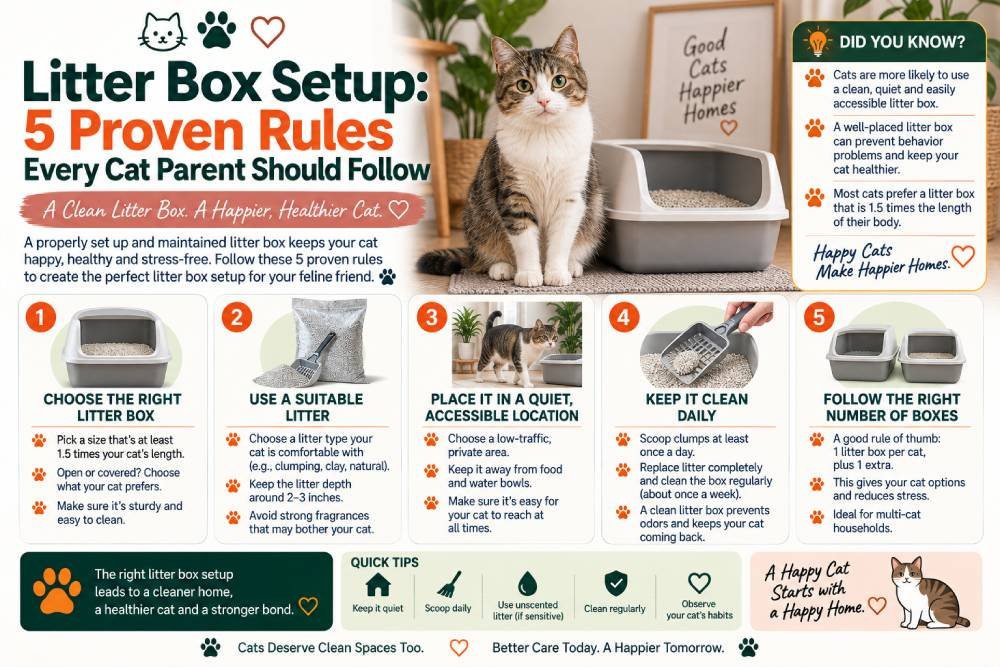
Litter box setup tips get treated as an afterthought until a cat starts avoiding the box entirely — at which point owners often assume it’s a behavioural problem, when in the vast majority of cases it traces back to one of a handful of fixable setup issues.
Five Litter Box Setup Tips
Most litter box avoidance issues trace back to one of these five, so working through them in order before assuming a deeper problem saves considerable frustration.
- Provide one box per cat, plus one extra. A single-cat household still benefits from two boxes, and multi-cat households need this ratio followed strictly to avoid resource competition and reduce territorial tension between cats.
- Place boxes in quiet, accessible locations, away from noisy appliances or high-traffic areas that might make a cat feel exposed while using it, since a startling noise during use can create lasting avoidance on its own.
- Scoop at least once daily, since cats are highly sensitive to a soiled box and will often avoid one that isn’t cleaned frequently enough, sometimes choosing a rug or floor corner instead.
- Choose an unscented litter in most cases — heavily scented litters are for owners’ benefit, not cats’, and can actually deter use since a cat’s sense of smell is far more sensitive than a human’s nose.
- Keep box size proportional to your cat, since a box that’s too small discourages proper use and can contribute to accidents just outside its edges, particularly as a kitten grows steadily into full adult size over its first year.
A cat avoiding the litter box is almost never being difficult — it’s telling you something specific about the box itself or something else entirely medical.
What research-backed guidance actually recommends
Ohio State University’s Indoor Pet Initiative provides detailed guidance specifically on litter box setup, recommending the one-per-cat-plus-one rule, appropriately sized boxes, and placement in low-traffic but accessible areas — all directly supporting the rules above with research-backed reasoning behind each one.
When avoidance points to something medical, not behavioural
A cat that was previously reliable and suddenly starts avoiding the box, especially if straining or vocalising while trying to urinate, needs a vet visit promptly — this can indicate a urinary blockage or infection, which is a genuine medical urgency rather than a setup issue.
Multi-cat households need extra attention
Cats can be surprisingly particular about sharing a box, even with cats they get along with otherwise. Spreading boxes across different rooms, rather than lining them up together, reduces the chance that one cat guards access and prevents another from using it comfortably — a common, under-recognised source of tension in multi-cat homes.
OrigiznPets currently focuses on dogs, so this guide is meant purely as a standalone resource — no service booking needed to put these litter box basics into practice.
Choosing between covered and open boxes
Covered boxes trap odour more than owners realise, making them less appealing to a cat’s far more sensitive nose, even when they seem tidier to a person. Most cats show a preference for open boxes, and offering both types initially helps identify which your specific cat prefers before committing to one style permanently.
Transitioning to a new litter or box type
Sudden changes to litter texture or box style can trigger avoidance on their own, even when nothing else is wrong. Introducing a new litter gradually, mixed with the old one over a week or two, avoids this being mistaken for a deeper behavioural or medical issue, and gives a cat time to adjust to the new texture at their own pace. This gradual approach also reduces stress, encourages consistent box use, and makes it easier to identify whether the change itself caused the unwanted behaviour.