

Common Cat Behavior Myths: 6 Proven Facts Every Owner Should Know
Cat behavior myths that lead owners astray: 6 proven facts that correct common misunderstandings about how cats actually think and act.

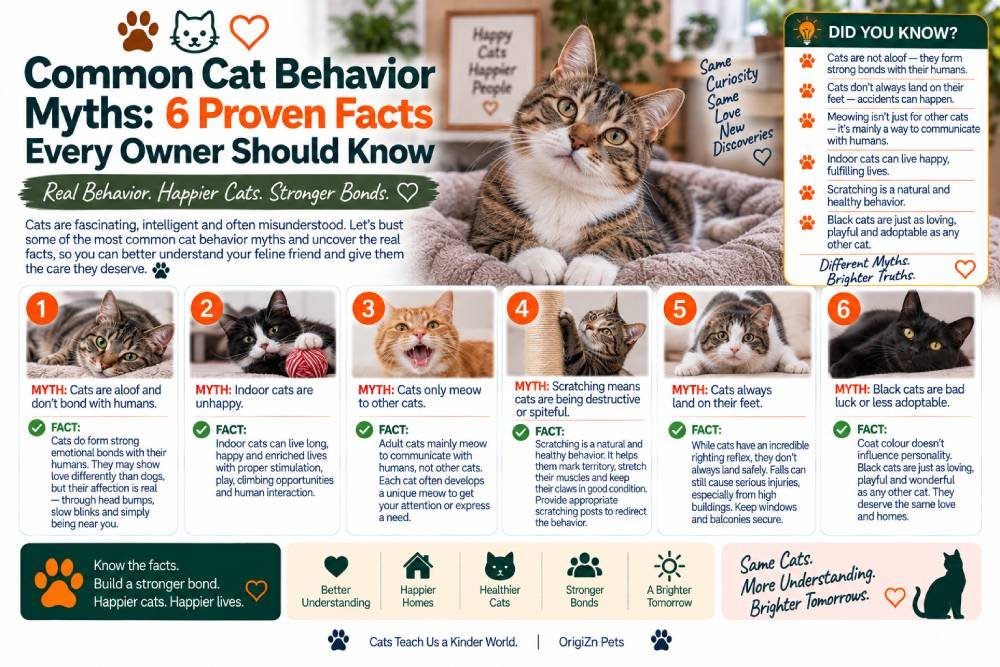
Cat behavior myths persist partly because cats are genuinely harder to read than dogs, and partly because old assumptions about “aloof” or “spiteful” cats get repeated without much scrutiny. Correcting a few of the most common ones changes how owners interpret everyday behaviour.
Six cat behavior myths worth correcting
Each of these shows up constantly in everyday conversation about cats, often repeated as established fact without much scrutiny.
- Myth: cats are naturally independent and need little interaction. Fact: cats form genuine attachments and need regular engagement — they simply show it differently than dogs do.
- Myth: a cat knocking things off shelves is being spiteful. Fact: this is typically exploratory or attention-seeking behaviour, not an emotional response to something the owner did.
- Myth: purring always means a cat is happy. Fact: cats also purr when stressed, in pain, or self-soothing, so context matters more than the sound itself — a purring cat at the vet is often anxious, not content.
- Myth: cats can’t be trained. Fact: cats respond well to reward-based training, they simply require shorter, more frequent sessions than dogs typically need.
- Myth: a cat using the litter box inconsistently is being difficult. Fact: this is frequently a medical or environmental issue, not a behavioural choice, and treating it as defiance usually delays finding the actual cause.
- Myth: cats don’t get bored the way dogs do. Fact: unmet enrichment needs in cats show up as different behaviours — overgrooming, aggression, vocalising — but boredom affects them just as much, just with less obviously disruptive signs than a bored dog typically shows.
Most “difficult” cat behaviour is actually a cat communicating something specific — the difficulty is usually in the owner’s interpretation, not the cat’s intentions.
Why these myths persist
Cats communicate through subtler signals than dogs — a flick of the tail, a slow blink, ear position — and owners unfamiliar with reading these cues default to human-centric explanations like spite or stubbornness that don’t reflect how cats actually process their environment.
What actually explains most “problem” cat behaviour
Ohio State University’s Indoor Pet Initiative frames much of what owners label as bad behaviour as unmet environmental or medical needs — a message that runs directly counter to the “spiteful cat” framing many of these myths rely on.
How this connects to litter box and enrichment issues specifically
Two of the most commonly misread behaviours — litter box avoidance and destructive exploring — are covered in more depth in our guides on litter box setup and indoor cat enrichment, both of which address the actual underlying causes these myths tend to obscure rather than treating the behaviour as an isolated quirk of temperament.
OrigiznPets currently focuses on dogs, so this guide is meant as a standalone resource for cat parents working through their own cat’s behaviour, independent of any service booking.
Reading a cat’s tail as a genuine communication tool
A slow, gentle tail sway signals contentment, while rapid thrashing usually signals irritation or overstimulation — nearly the opposite of what many owners assume based on how dogs use their tails. Learning this one signal alone corrects a surprising number of the myths above, and it’s often the first thing new cat owners notice once they start paying attention.
Why cat body language deserves the same attention as dog body language
Owners often invest time learning to read dog signals but assume cats are simply unreadable. In practice, cats communicate constantly through subtle posture and ear position — the signals are just quieter and easier to miss without deliberately paying attention, and a few weeks of conscious observation usually changes how an owner reads their cat permanently.
How cat owners can respond more effectively
Instead of reacting to unwanted behaviour with punishment, start by looking for the reason behind it. Changes in routine, limited play, stress, unfamiliar people, household changes, or discomfort can all influence how a cat behaves. Offer safe spaces, predictable routines, interactive play, scratching options, and appropriate enrichment. When behaviour changes suddenly or persists despite environmental improvements, a veterinary check is important to rule out an underlying health problem. Understanding the cause rather than assuming bad intentions helps owners respond calmly and builds a more trusting relationship with their cats.