

Separation Anxiety in Apartment Dogs: What Helps
Separation anxiety in apartment dogs often looks like boredom at first. Here's how to tell the difference and what actually helps.

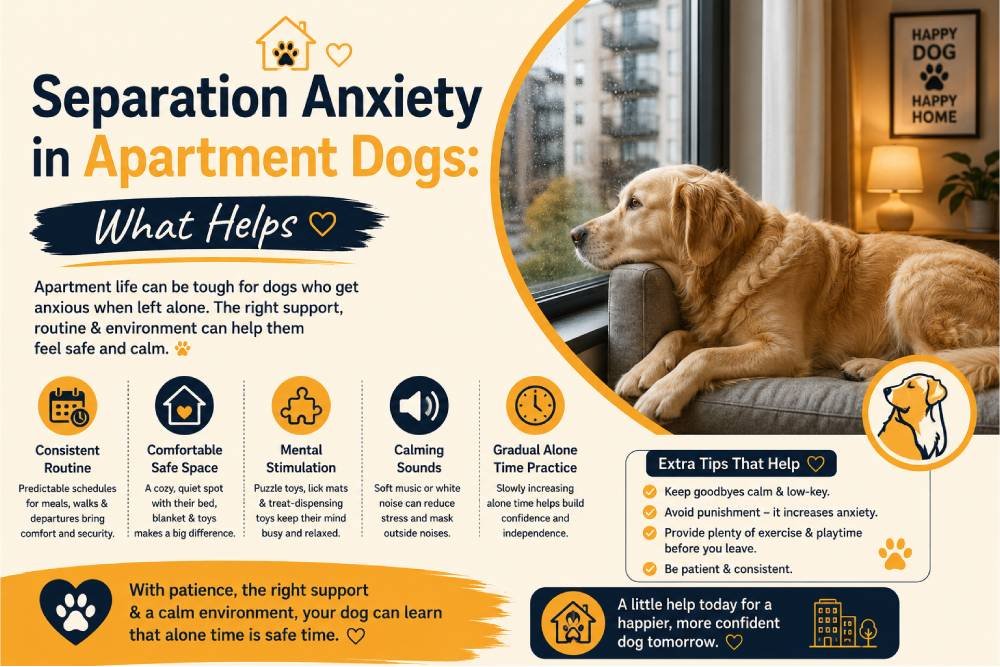
Separation anxiety in apartment dogs often looks like ordinary boredom at first — a chewed cushion corner, a bit of whining by the door — which is exactly why it usually gets missed until the pattern is well established. In a smaller living space, the signs are also harder to separate from normal apartment noise: a neighbour’s footsteps, a lift ping, a door two floors down.
What separation anxiety in apartment dogs actually looks like
True separation anxiety in apartment dogs tends to start within minutes of you leaving, not build up gradually over hours. Look for pacing near the door, drooling that wasn’t there before you left, destructive chewing focused specifically on exits (doorframes, window sills), and vocalising that a neighbour has mentioned but you’ve never actually witnessed, since it typically starts the moment you’re gone and stops when you return.
Why apartments make separation anxiety harder to spot and to fix
Separation anxiety in apartment dogs is complicated by close quarters in both directions. Shared walls mean whining or barking becomes a neighbour complaint faster than it would in a house, which pushes owners toward quick suppression — a bark collar, constant reassurance — rather than addressing the underlying anxiety. At the same time, a smaller space gives a dog less to do while alone, which can make ordinary boredom look identical to genuine anxiety until you’ve actually ruled it out.
Ruling out boredom before assuming it’s anxiety
Before treating it as separation anxiety in apartment dogs specifically, check the basics: a proper walk or play session before you leave, a puzzle feeder or chew available during the day, and water within reach. If distress only appears on days you skip the pre-departure walk, that’s understimulation, not anxiety, and it has a much simpler fix.
A dog that’s anxious the moment you leave is different from a dog that gets bored an hour in — and the fix for one can make the other worse.
Three things that help with separation anxiety in apartment dogs
- Practice departures that don’t mean anything. Pick up your keys, put on your shoes, and sit back down — repeatedly, with no actual departure. This breaks the association between pre-leaving cues and the anxiety spike that follows them.
- Build absences in seconds, not hours. Start with departures of 10–30 seconds and extend gradually only once your dog is calm at the current duration. Jumping straight to a full workday is the most common mistake we see with separation anxiety in apartment dogs.
- Separate “alone” from “confined.” If your dog is anxious about a crate as well as about being alone, work on the two separately — combining them tends to intensify both.
What doesn’t help separation anxiety in apartment dogs
Leaving a dog to “cry it out” doesn’t resolve the underlying anxiety and can add a layer of learned helplessness on top of the original problem. A 2014 clinical review of canine separation-related behaviour found that punishing the resulting damage or vocalising after the fact typically worsens the anxiety rather than reducing it, since the dog cannot connect a delayed punishment to the panic that caused the behaviour in the first place.
When to bring in outside help
If departures under thirty seconds still trigger visible distress, or the anxiety has been present for months without any change, that’s usually past the point where departure practice alone will fix it. A trainer who can observe the specific triggers in your actual apartment makes the difference at that stage, rather than troubleshooting from a description of it.
Our training and walking services include at-home separation anxiety work, structured around your actual apartment and routine rather than a generic plan. Book a free demo to have a trainer assess it in person.